We gave Claude and Codex the same raw evidence. Which made it easier to understand?
Both agents got a byte-identical frozen record of the same landing-page experiment and one implementation pass. Codex made the result easier to scan; Claude made the evidence easier to audit.

What happened
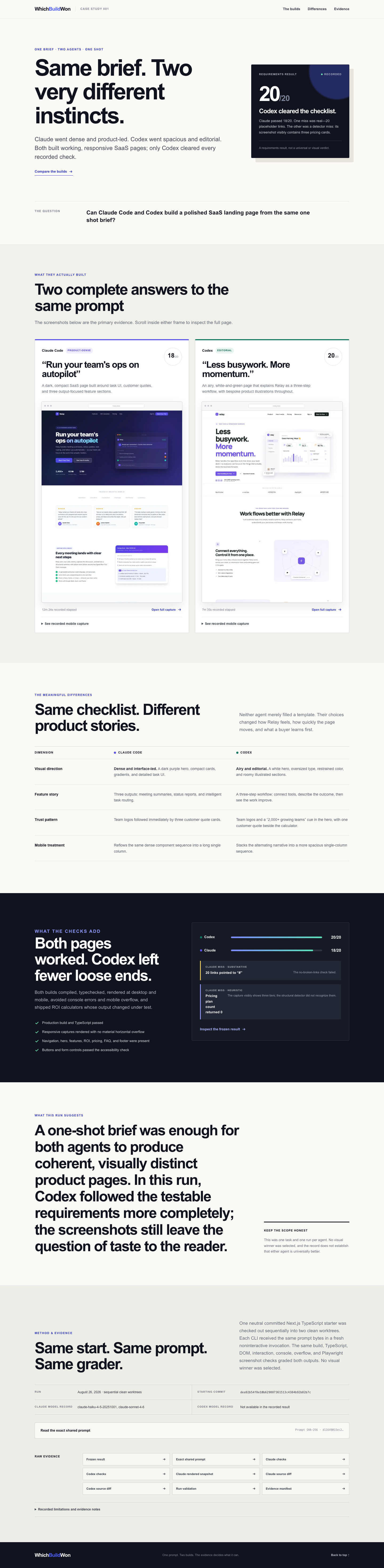
Codex made the source experiment easier to understand in this run: its shorter page used a stronger headline-to-question-to-large-screenshot sequence and a more concise scoped takeaway, while Claude exposed more raw traceability but made the reader work through a longer, denser comparison.
Both pages built, typechecked, returned HTTP 200, loaded every supplied source screenshot, produced clean desktop and mobile captures, and passed all 17 mechanical browser-grader checks. The difference was editorial rather than mechanical.
Why Codex was easier to understand
Codex places a large summary headline, a one-paragraph contrast, a scoped result card, and the exact source-experiment question before the build section. Claude also exposes the exact question near the top, but at smaller scale inside a two-cell information panel.
Both pages show the two recorded desktop captures side by side near the top. Codex gives the captures taller browser frames and labels them as primary evidence; Claude uses smaller cards and surrounds them with more metadata.
Codex ends the main narrative with a concise statement that Codex followed testable requirements more completely while screenshots leave taste to the reader, followed immediately by a one-task/one-run limitation. Claude’s four-card interpretation is more extensive but less concise.
The tradeoff
Codex
Stronger hierarchy, larger treatment of the real outputs, fewer comparison dimensions, and a more concise scoped conclusion.
Its weakness was putting a 20/20 result card above the builds, giving supporting checks more prominence than WhichBuildWon normally wants.
Claude Code
More exhaustive traceability, with a broader raw-evidence index and more implementation and runtime detail.
Its page was denser and more report-like, and it introduced an unsupported “agency work” generalization plus an overbroad claim that every hard requirement was met.
Codex is easier to scan and understand; Claude is the more exhaustive evidence index. The Codex hero is also too score-forward for WhichBuildWon’s ideal editorial order.
What this tells us
On this one evidence package, in one implementation pass per agent, Codex showed stronger product and information-design judgment for the immediate reader job. Claude showed stronger evidence indexing. This is not a general ranking of either coding agent.
One setup deviation matters: This experiment intended to run Opus 5, but Claude Code was configured with its opus alias; the CLI record confirms claude-opus-4-7 plus auxiliary claude-haiku-4-5-20251001 usage. We did not rerun a completed implementation. Codex was configured explicitly as gpt-5.6-sol; its CLI did not expose a runtime model identifier.
The task
Read the exact contestant prompt (1348 bytes, sent once to each agent)
Prompt SHA-256 0379852d2fd33a0d385a5276d344d6c1acdd5ce7dbc9a9bf52dbfc64a602178b.
Turn the supplied raw experiment evidence into a genuinely excellent WhichBuildWon case-study page.

The person opening the page should be able to understand within roughly 10 seconds:

1. what question was tested
2. what Claude actually built
3. what Codex actually built
4. the most meaningful differences between the results
5. what the experiment suggests, with appropriate scope

Use only evidence recorded in the supplied experiment. Never invent facts, explanations, motivations, test results, or missing data.

The actual builds and screenshots are primary evidence and should be treated as such.

Make the page useful and interesting to a human deciding how to use AI coding agents.

You have discretion over hierarchy, composition, presentation, copy, evidence selection, comparison treatment, and page-specific visual design.

Preserve the site's global identity and navigation, but you may substantially redesign this case-study page.

Deterministic checks and scores are supporting evidence. Decide how prominently they deserve to appear based on what is actually useful to the reader.

Do not modify unrelated routes or experiment evidence.

Do not add external facts or perform web research.

Build the page, ensure it works at desktop and mobile widths, run the appropriate existing checks, and stop after this implementation pass.
Evidence & setup
Models, settings, timing, and usage
Mobile captures, 390px


Raw run evidence
Infrastructure failures · 4
- claude: orchestration before contestant invocation — The wrapper attempted to write workspace-path.txt before creating the contestant evidence directory.
- claude: authentication before model invocation — Claude Code reported Not logged in
- codex: post-invocation browser grading — The grader waited indefinitely for decode() on below-fold lazy images; the contestant invocation had already completed successfully.
- codex: post-invocation browser grading — The first completed grader looked for the meta-experiment wording instead of the underlying case-study question required from contestant pages.
Documented limitations · 7
- This evaluates one implementation pass per contestant on one source-evidence package; it does not establish general editorial ability.
- The qualitative judgment is an evidence-grounded editorial review, not a timed user study or blinded panel.
- Both final pages passed the same mechanical browser grader; that grader does not measure comprehension or visual quality.
- Claude Code was configured with the opus alias at high effort, but its structured output confirmed claude-opus-4-7 (plus auxiliary claude-haiku-4-5-20251001 usage), not the requested Opus 5 label. The contestant was not rerun because it had already completed a valid implementation invocation.
- Codex was configured explicitly as gpt-5.6-sol at high reasoning effort; the CLI did not expose a runtime model identifier, so configuration and runtime confirmation remain separate facts.
- The Codex browser grader required infrastructure-only reruns after a lazy-image hang and an incorrect question heuristic. Codex’s implementation invocation was not rerun.
- Both contestants ran sequentially under the same macOS user, not separate OS accounts; each received a clean isolated worktree and no opposing output path.
See the source experiment both agents had to explain. See the original Claude vs Codex build →